How the Kaaifeest uses art to build a sustainable, inclusive, and beautiful waterfront
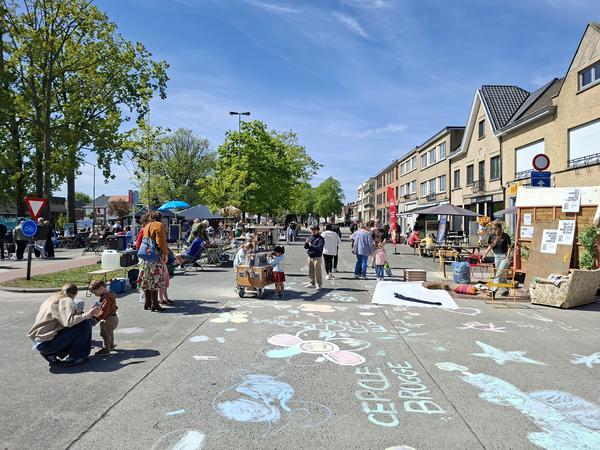
The Kaaifeest in the Kaaidistrict of Bruges stands as a powerful example of how small and big artistic interventions can transform public space while strengthening community bonds. Through activities such as kids chalking on the street, urban knitting, school children making noise for water, dance performances, and participatory street art, the Kaaifeest actively contributes to rethinking the area as a sustainable, inclusive, and beautiful place, in line with the values of the New European Bauhaus.
At its core, the Kaaifeest demonstrates how urban planning and community building can reinforce one another. By inviting residents to co-create and experiment with public space, the party acts as a living laboratory where ideas for the future of the Kaaidistrict are tested in an accessible and human-centered way. Artistic interventions play a crucial role in this process: they make abstract planning ideas tangible, while promoting a shared sense of ownership among participants.
Kids chalking on the street: reclaiming space for a greener and car-free future
One of the most visible and impactful activities of the Kaai-party has been kids chalking on the street. For a moment, the street was transformed into a canvas of imagination, filled with drawings, games, and colours. Yet this playful intervention carries a deeper message: it reclaims space typically dominated by cars and repositions it as a place for people.
This temporary transformation helps residents envision a car-free crossroad, where trees and plants can flourish, a public square can emerge, and social interaction becomes central. By allowing children and families to collectively inhabit the street, the intervention strengthens community ties and provides a compelling argument for permanent urban redesign. It embodies NEB values by demonstrating how urban spaces can be inclusive (accessible to all), sustainable (reducing cars, adding green), and beautiful (vibrant and creative).
School children connecting water to their neighbourhood
A particularly meaningful component of the Kaaifeest has been the involvement of school children, who created an artistic intervention focused on the theme of water and its connection to the neighbourhood.
Their project began with a procession through the Kaaifeest and surrounding streets, where the children played self-made musical instruments, guided by a professional musician. This journey through the neighbourhood symbolized the flow of water and connection between places and people.
After the tour, the children performed on the Kaaifeest podium, playing music and presenting a visual artwork reflecting on the relationship between the community and the waterfront. Their final piece, expressing how water connects, shapes, and sustains the neighbourhood, will be permanently displayed on the roundabout until the end of 2026.
This intervention is especially powerful because it brings young voices into urban development, showing how future generations perceive and value their environment. It reinforces inclusivity while linking cultural expression to environmental awareness and spatial identity.
Dance performances: activating space through expression and participation
The presence of a local dance school at the Kaaifeest brought movement and emotion into the urban landscape. The performances attracted a diverse audience, turning the waterfront into a lively cultural stage.
Dance functioned as both a form of expression and invitation. It drew people into the space and encouraged them to stay, connect, and participate. After the performances, open workshops allowed attendees to engage directly with the dancers, breaking down barriers between performers and the audience.
This interaction exemplified how cultural programming can activate public space, making it more inclusive and accessible. It transformed the Kaaidistrict into a place not just to pass through, but to experience.
Urban knitting: tactical urbanism rooted in care and inclusion
The urban knitting project illustrates how small-scale interventions can have large social impacts. Using recycled and leftover wool, overly-enthusiastic participants created fabric pieces that now wrap more than 30 trees in the Kaaidistrict. This initiative is a striking example of tactical urbanism: low-cost and community-driven ideas' testing for urban change.
What makes this project particularly meaningful is its social dimension. Many of the knitters were socially vulnerable individuals, alongside groups from elderly care homes, turning the act of creation into an opportunity for inclusion and empowerment. The result is both visual and symbolic: the decorated trees highlight sustainability through reuse while representing a collective act of care for the public space and for one another.
In this way, urban knitting connects the dots between environmental awareness, social cohesion, and aesthetic enhancement, reinforcing the NEB values while demonstrating how art can promote community-driven urban transformation.
Tactical urbanism beyond knitting: Valentine hearts
Beyond urban knitting, initiatives such as the Valentine hearts installation further demonstrate the power of tactical urbanism in the Kaaidistrict. These temporary interventions invite emotional connection and participation, encouraging residents to engage with their surroundings in new ways.
Such projects show how even small gestures can have a cumulative impact on how people perceive and use space, gradually building momentum for more structural changes in urban planning.
Street art: a lasting symbol of collective identity
The street art created during the Kaaifeest 2025 continues to shape the identity of the area long after the event end. The murals, created with input and ideas from local residents, serve as permanent reminders of collective creativity and connection.
Unlike traditional top-down urban design, the participatory approach used ensures that the artwork reflects the voices, stories, and aspirations of the community. It strengthens local identity and fosters a sense of belonging, proving that beauty in public space is most powerful when it is co-created.
Art as a catalyst for sustainable urban transformation
Taken together, the artistic activities of Kaaifeest illustrate a broader principle: artistic interventions can serve as catalysts for sustainable urban transformation. They allow communities to experiment, express, and co-create. In the Kaaidistrict of Bruges, this approach has created a feedback loop where:
- Urban planning ideas inspire artistic interventions, and
- Community participation through art informs future planning decisions.
This synergy ensures that transformation is not imposed but emerges organically from the community itself.
Conclusion
Kaaifeest was more than a one day party. It is a model for how cities can evolve through collaboration, creativity, and care. By grounding activities such as chalk drawings, knitted trees, dance performances, street art, and tactical installations in the NEB values of sustainability, inclusivity, and beauty, the Feest demonstrates how waterfronts like the Kaaidistrict can be reimagined as spaces that truly belong to people.


Publishing date:
Authors: City of Bruges (Stad Brugge)
Related projects
Related multimedia
Related Cities

The sole responsibility for the content of this website lies with the project and in no way reflects the views of the European Union.