Helsinki, Karlsruhe and Utrecht are reclaiming their streets for living
On 12 November 2025, the first Re-Value Expert Exchange brought together urban practitioners and city representatives to explore how streets and public spaces can be reclaimed for human wellbeing and environmental resilience. The session showcased a variety of inspiring approaches from European cities beyond the Re-Value project.
Roni Utriainen from the City of Helsinki presented Helsinki’s Vision Zero initiative, highlighting how a fundamental shift from “user blame” to system design has reshaped the city’s approach to road safety. This strategy is already showing great results: Helsinki recorded twelve consecutive months without a single traffic fatality, a significant milestone for urban safety. More than half of the city’s streets now carry 30 km/h limits, and new mobility infrastructure - including a major bridge reserved exclusively for trams, pedestrians, and cyclists - signals a broader commitment to sustainable transport. Roni also outlined how the city’s strategic use of speed cameras has reduced excessive speeding even beyond camera locations, illustrating lasting changes in driver behaviour. With a 41% walking share and an ~80% combined sustainable mode share, Helsinki exemplifies a city truly built for people, not cars.
Prof. Florian Otto showcased Karlsruhe’s award-winning sponge city concept at the Central Station, demonstrating how streets must now adapt not only for safety but also for rising climate stresses. The redesigned station square blends blue-green infrastructure to absorb stormwater, reduce heat, and create comfortable public spaces, achieving cooling effects of up to 10°C during heatwaves. Beneath the surface lies an advanced soil-water system that keeps trees healthy even in drought. The project features 20 different tree species, embracing biodiversity and long-term resilience over uniform planting schemes. In his presentation, he highlighted how streets can serve as multifunctional civic landscapes and essential climate infrastructure, not merely transport corridors.
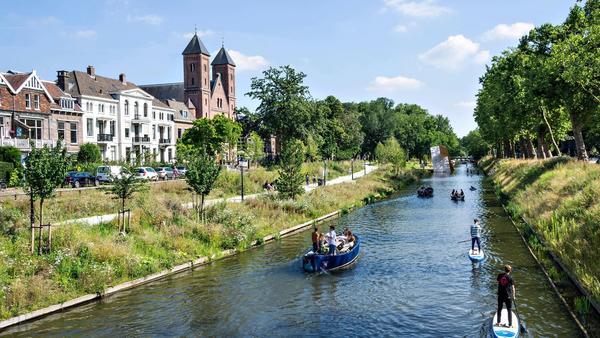
Wim Voogt from the landscape architecture firm OKRA shared the story of Utrecht’s Catharijnesingel - an urban fairy tale in reverse, where a highway from the 1960s has been restored into a green-blue canal and thriving public realm. The redesign reconnects Utrecht’s historic centre with surrounding districts, replacing car parking with continuous parkland, biodiverse riverbanks, new bridges, and carefully designed underwater habitats for fish, even including a playful but functional “fish doorbell” to aid ecological flows. The canal is now one of the city’s most beloved spaces and a powerful demonstration of how bold design can reshape both places and public attitudes. Wim also highlighted other coastal protection projects from OKRA’s portfolio, showing how design can bridge climate adaptation and public space quality.
Throughout the exchange, participants discussed challenges, shared experiences, and gathered ideas to apply in their own cities. By featuring examples from outside the Re-Value network, the session offered fresh perspectives and concrete illustrations of how different approaches, from policy and planning to design and small-scale interventions, can work together to make urban spaces more livable, inclusive, and climate-resilient.
Missed the Expert Exchange or want to revisit the insights? You can watch all three presentations:
Publishing date:
Authors: ICLEI Europe

The sole responsibility for the content of this website lies with the project and in no way reflects the views of the European Union.