Bruges brings neighbours together to re-value its waterfront
What started with a simple door-to-door conversation in Bruges’ Kaaidistrict has grown into a neighbourhood movement now making headlines in the local press. Through the Re-Value project and the ongoing Re-Value Your Waterfront campaign, residents, local organisations, and the City of Bruges are showing how small community-led actions can gradually reshape the future of an urban waterfront district.
The first steps began in summer 2025, when project partners and local volunteers visited residents in the Vaartstraat and Sint-Pietersgroenestraat to speak about the future of the neighbourhood. At the time, expectations were modest. Yet those conversations planted the seeds for something much bigger.
By the end of 2025, an after-work gathering held in the neighbourhood’s “chicken tea garden” unexpectedly led to the creation of a new citizen committee. Residents who had only recently met each other began organising activities, exchanging ideas, and taking ownership of shared public spaces. The Re-Value SeaTowel, travelling across Europe as part of the #ReValueYourWaterfront campaign, became a familiar symbol during several of these community moments, helping connect local actions in Bruges to a wider European conversation about sustainable waterfronts.
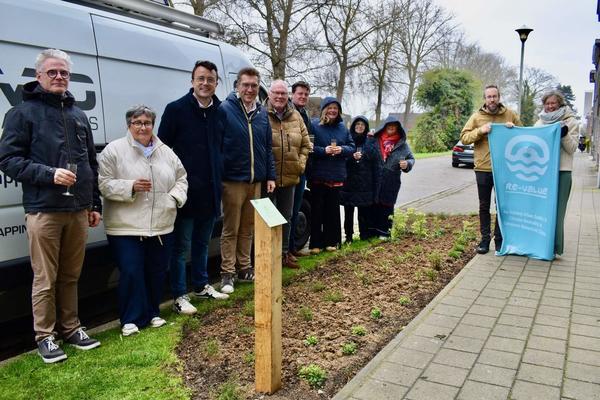
Now, the neighbourhood committee has taken on a new role. Eleven public green spaces in front of homes and apartment buildings in the Kaaidistrict have officially received local “godmothers” and “godfathers” responsible for helping care for them. In exchange, residents were invited to help choose the planting schemes for the spaces, which now include lavender, coneflowers, gaura and hellebores.
The initiative attracted significant local media attention and was celebrated during a joint press moment organised by Bruges’ Alderman for Public Domain and the Alderman for Urban Development and Spatial Planning.
According to local newspaper Nieuwsblad and HLN, around 140 square metres of paving and grass have already been transformed into greener areas across the neighbourhood. The article described the initiative as an example of how “residents, the city and partners can strengthen a district together”, highlighting how even small green interventions can create a better everyday environment.
The momentum has continued to spread throughout the Kaaidistrict. Alongside the new green spaces, residents and volunteers have launched colourful urban knitting installations around neighbourhood trees, prepared activities for the second edition of the Kaaifeest community celebration, and contributed ideas for the temporary K.aaibar meeting space planned on the site of a former petrol station.
Many of these activities build on earlier Re-Value actions already taking shape in the district. Over the past year, residents transformed the Spinnerijpad former railway line into a green corridor with willow tunnels, insect hotels, wildflowers, herb planters and benches made from recycled plastic collected locally. Together, these interventions show how tactical urbanism and community participation can gradually change the atmosphere of a neighbourhood while preparing the ground for longer-term regeneration.
For Bruges, the growing attention from residents and local media confirms that waterfront transformation is not only about infrastructure and redevelopment plans, but also about creating opportunities for people to meet, care for shared spaces, and imagine together what their district could become.
As the Re-Value Your Waterfront campaign continues across Europe, the Kaaidistrict is showing that meaningful urban change can begin with something as simple as a conversation at the front door, a shared activity in the street, or a towel travelling from one waterfront city to another.

Publishing date:
Related Cities

The sole responsibility for the content of this website lies with the project and in no way reflects the views of the European Union.